Small Fables
Essay by Keely Shinners
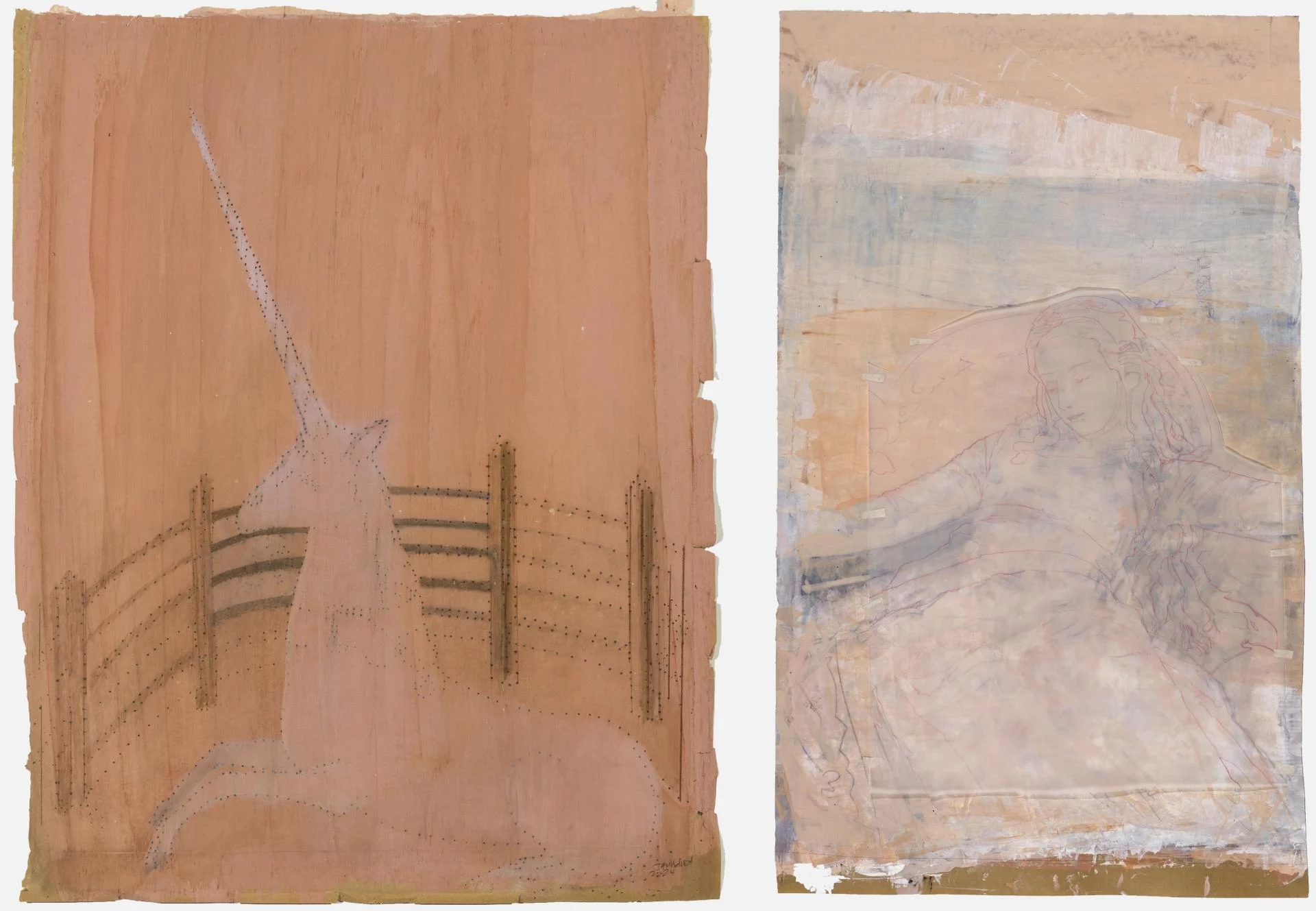
Right: Sleeping Princess, 2025, Mixed media on paper, 90 x 50cm
Sleeping Beauty. Her image recurs again and again in Josie Grindrod’s exhibition, Small Fables, presented as part of the Cubicle Series at Everard Read in Cape Town. There she is, above the fireplace, sketched in pink crayon, gazing demurely into the middle distance; no longer a child, but not yet a woman, her expression is aimless––a little lost. She’s there again in a small painting on paper, shrinking shyly in shadow. In a photocopy of an engraving, blown up and pinned to the wall, she is asleep; crows circle her, and the dream palace in which she has been held hostage has fallen to ruin. Everywhere––in sketches, stencils, collages, and found objects––there is her motif: a rose.
When I think of Sleeping Beauty, it is motifs that spring to mind. A rose. A prick. A kiss. Small Fables, which is “interested in how images are carried forward in culture,” made me curious: where did these motifs originate? How have they changed over time?
The fairy tale has its origins in a fourteenth century courtly romance and has been revised over the past seven centuries. Each revision contains traces––faint, but nevertheless discernible––of social and cultural upheaval. For instance, in an early seventeenth century version of the story, Sleeping Beauty is pricked by a splinter of flax. In a version published sixty years later, however, the splinter of flax is replaced by the spindle of a spinning wheel. This subtle shift from material to machine––is it a coincidence that this narrative turn occurred concurrently with the Scientific Revolution? Another example: in an early recount, Sleeping Beauty is raped and gives birth to twins while she is still asleep. In the Brothers’ Grimm version, however––published nearly two centuries later––the Prince wakes her with a kiss. A more humane tale, certainly, but perhaps one that hinges on society’s increasingly anxious attitude towards the idea of a woman’s purity.
Sleeping Beauty is only one of the fairy tales that have influenced Grindrod’s exhibition, which is punctuated by their associated archetypes: unicorns, frogs, lions, hares, tortoises, swans, snakes. Grindrod is fascinated by traces of social history and issues of power, such as those I’ve mentioned above, that can be found in fairy tales. She is critical of their normalisation of the aristocracy, for instance, and the morals they tend to impose on their audiences. At the same time, fairy tales are deeply nostalgic and aesthetically inspirational for Grindrod. A collector of children’s books, Grindrod is interested in how tales of enchantment are rendered visually, on the one hand and, on the other, how these visuals are “mediated by technologies” that reproduce and transform them.
Grindrod is inspired by the “animist sense of wonder at transmutation” that is taken for granted in the visual language of fairy tales. A frog becomes a prince. A wolf becomes a grandmother. A hare sits at the table for tea. This fluidity between human and animal is, in her view, a counter-response to Enlightenment-era emphasis on rationality, veracity, and empiricism that have come to define Western society. Grindrod sees the value in recovering a more poetic sensibility, a reacquaintance with the natural world that might help us to navigate the ecological crises that are sure to define the remainder of the twenty-first century.
I see this poetic sensibility at work in Book of Hours, a painting based on The Unicorn Rests in a Garden, one of seven tapestries created in the South Netherlands around 1495–1505. Read in sequence, the tapestries tell a story about a unicorn that is hunted, captured, taken to a castle, and chained. Book of Hours focuses on the final beat in the narrative, when the unicorn is enclosed in a corral. From a contemporary vantage point, I can’t help but see this image as an allegory for the many ways in which the mythical, mystical, and imaginative have been corralled, so to speak––dismissed as superfluous, subordinate, or downright obsolete. The fact that Grindrod’s scene is a blood-red haze in which only the silhouette of the unicorn can be made out––compared to the original version, which shows the unicorn shining bright white against a botanical dark green background––reinforces this notion. Ours is a world, Grindrod suggests, in which our imaginative capacity––our proclivity for the wayward and mysterious––is under threat. So too is the natural world, whose constitutional ungovernability shores up against our society’s insatiable desire for control.
Grindrod’s project, thus, is to restore a sense of imagination to the anthropocentric present, a process that has involved experimentations with a diverse range of media. She does this by mediating one signifier through multiple different technologies. Let’s look at the signifier of the lion, for example. In Small Fable, we can see him rendered in painting using a pouncing technique and flanked by sculptures that resemble theater props. In a collage on the opposite wall, a similar image is reproduced as a drawing in charcoal, crayon, and ink. He crops again as a black paper cut-out silhouette, then a fourth time as the underside of a blown-up photocopy, splattered red. While the subject stays the same, the imaginative aspect comes into play in the act of making. Piercing, painting, tracing, cutting, sticking, layering, copying, arranging, collaging––in the age of mechanical reproduction, we might tend to think about these processes as distorting the veracity of the image; for Grindrod, however, these acts are freeing. To be open to the possibilities of what an image––or an object, or a simple sheet of paper––can be: this is the basis of enchantment.