Fragilising & Resistance Narratives
“And even God is not what he said he was; he is recast as a process of becoming, the notion of something sacred and visual in the midst of being formed” (Butler, 2006: xi).”
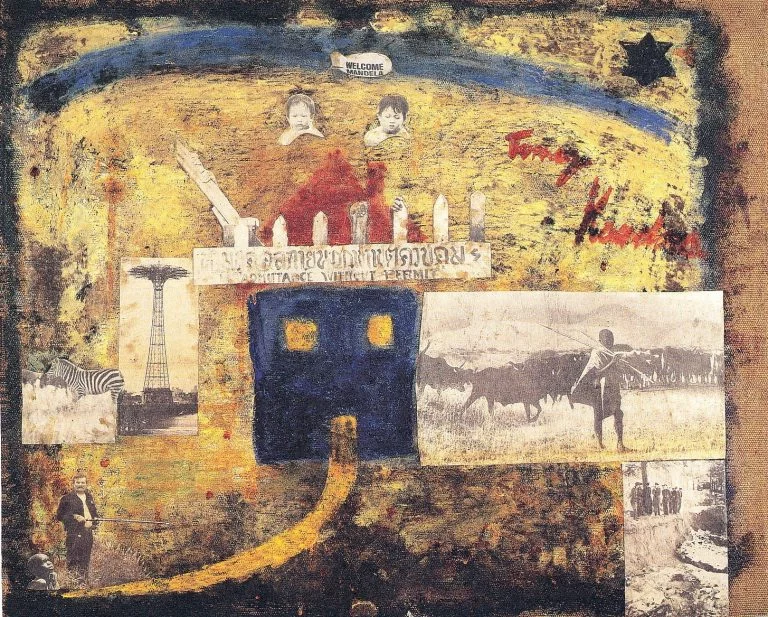
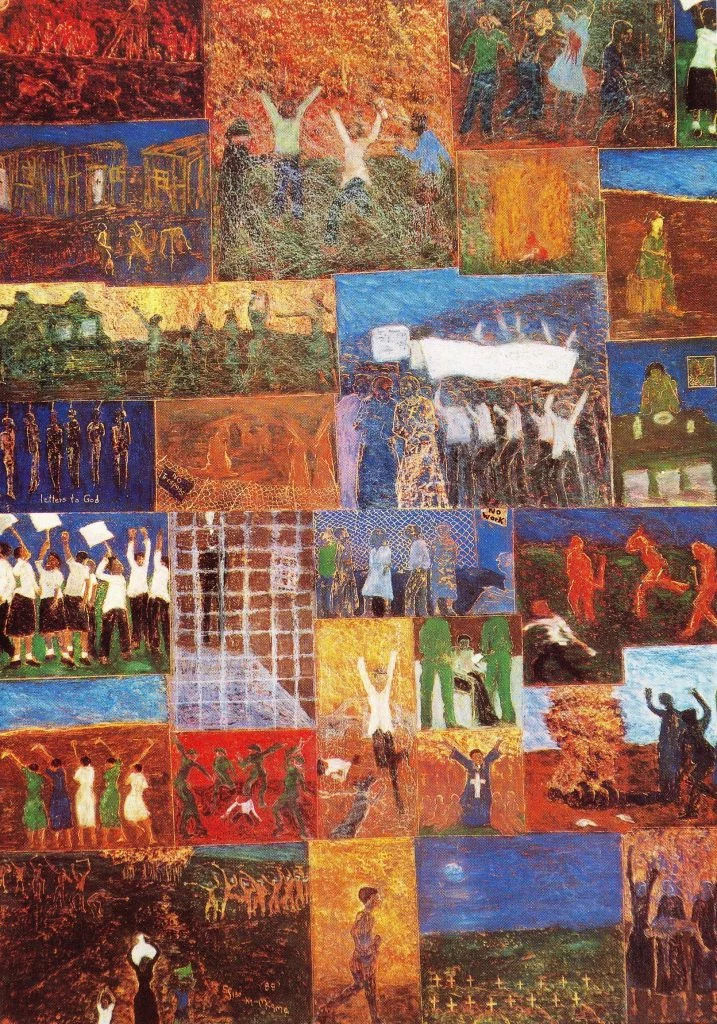
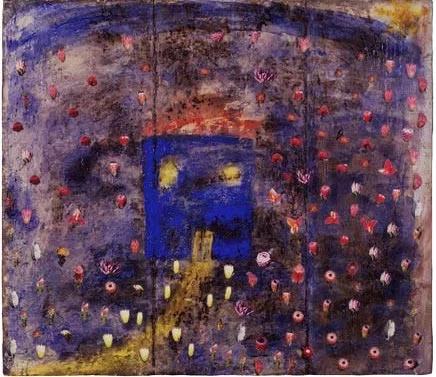
My contribution to this conference draws from my practice as a painter. In pursuit of generating a conceptual and material working method of my own, I wish to learn from two images which continue to move me deeply: Letters to God (1988) by Sfiso Ka Mkame and Tomaz’s Garden (1990) by Vivien Koorland. Dealing with alterity and social violence under Apartheid and the Holocaust respectively, each work continues to speak powerfully to contemporary culture, a culture characterized by many as one of trauma (Richards, 2006: 262). Under such conditions, impaired or arrested symbolic functioning may be evident in the subject (Kalsched, 1996: 23)[1]. From this perspective the role of art in restoring symbolic capacity may be considered of profound social value (Watson, 2007: 16)[2].
However, like many artists, I seek a critical practise which goes beyond a renovation of the existing Symbolic, motivated instead by the possibility of expanding or transforming it. In this paper, contemporary psychoanalytic aesthetics are drawn on to consider how, as structures of psychic meaning (Harris Williams, 2010: 134), Letters to God (1988) and Tomaz’s Garden (1990) may allow “what has not yet been thought” to reach awareness, and empathic response be elicited in the viewer (Arnold and Iversen, 2003: 6). It will be suggested, following analyst/artist Bracha Ettinger, that in addition to their overt symbolic imagery, the works may also be read for a feminine “sub-symbolic” dimension, one making the transmission of transformatory affect possible. My paper will first examine the overt symbolic dimensions of the works under discussion, before considering their latent or sub-symbolic realms.
Letters to God (1988) is a pastel drawing made using the scraffito technique. Ka Mkame’s format comprises two exactly equal paper surfaces joined horizontally and covered with drawn squares and rectangles which create a dense mesh of interlocking planes. Filled with visual vignettes, the work ostensibly narrates the intense resistance of civic society to Apartheid, particularly the key role played by the Church in the liberation movement[3]. Tomaz’s Garden, a densely layered work combining collaged and painted elements, commemorates the life of Tomaz Kauders, a child interned in the ghetto of Terezin in Poland during the Second World War (Dubow, 1998: 1).
The most apparent reading of each work draws on a clear visual symbolism; where Letters to God uses multiple images of the crucifix to evoke the human suffering caused by Apartheid – subliminally keyed for the viewer by the just-visible cross formation at the bottom of the work – Tomaz’s Garden uses the motif of a simply rendered house to stand for a child’s identity, referencing a drawing made by the boy published (along with the drawings and poems of other children from the ghetto who also perished there) in a book titled “I never saw another butterfly”.
A rich post-Kleinian psychoanalytic literature conceptualizes art as affective symbolic form born out of and integrating unconscious psychic tension (Deri, 1984: 45; Harris Williams, 2008: 62; Segal, 1991: 93, Winnicott, 1974: 15, 114, 116). As that which represents “drastic, excruciating forms of psychic tension” (Brown, 1994: 744) the crucifix visually embodies Ka Mkame’s lived emotional experience. Koorland’s work is similarly located; Tomaz’s Garden is counter-posed with Tomaz 1943 – 1990 (the first of the two allied paintings in which the artist introduces her subject). Thus in Tomaz 1943 – 1990, a blackened Star of David replaces the child’s original drawn sun and the painting evokes day, while in contrast, the saturated, studded blue surface of Tomaz’s Garden conjures night (Koorland, 2013: personal communication). Sunshine and starlight, light and dark, life and death are set against each other, these oppositions signifying, I suggest, both the specific situation the works address, as well as the psychic state of sustained tension which symbols “bridge over” (Deri, 1974: 252).
Additionally, however, other simultaneous psychic processes concerning representation may be seen to be in play. Ka Mkame and Koorland’s images also resist the given Symbolic, the movement from fixity to mutability this entails visible in multiple ways in each work[4].
In Letters to God this impulse may be seen in Ka Mkame’s figure/ground reversals (Deri, 1974: 36). In the lower left hand corner, menacing green figures trap a crouching, white-shirted victim within a field of red. Above, to the right, the situation shifts – the protagonist now occupies a ground of green against which Matisse-red figures dance[5]. This figure is dynamic; the blurred pastel markings which describe him connate agency and movement. Koorland too moves to redraw Tomaz Kauder’s poignantly singular experience beyond Symbolic determination. In Tomaz’ Garden the painting’s heavily encrusted tempera surface is embedded with postcard cutouts of South Africa’s national flower, the protea, a plant named for the god Proteas who could change his form at will (Walsh, 2013). By appropriating and re-contextualising a flower symbolically linked with Apartheid oppression, the flower itself a reference to mutability, Koorland signals her desire, I aver, to both identify with and to symbolically shift, Tomaz Kauder’s destiny.
The intensely felt drive to transform a seemingly fixed Symbolic may further be seen in Ka Mkame’s metaphoric use of fire. The drawn, blurred, pastel figure referenced earlier prepares to hurl a petrol bomb, thus visually announcing the destruction of established symbolic form I argue Letters to God enacts. Sustained in many of the inset images – not only in his depiction of flames and burning but also in his intensely rendered reds and oranges – fire here both evokes hellish realms and works to refigure such experience through the “burning off” and “melting down” of that which demarcates and separates[6] (Milner, 1952: 187-188). For fire’s mutable properties, like those of paint and pastel, may be used to “soften” the Symbolic, allowing a phantasied blurring of boundaries between entities rigidly held apart (Nixon, 2005: 205 – 206).
Yet the movement to destabilisation thus far described rests on the theoretical notion of a Symbolic involving discrete entities, one inadequate, I assert, to account for the processes and effects of the works under discussion. Ettinger’s radical psychoanalytic perspective on the feminine supplements a phallic framework and extends interpretive possibilities; following British analyst Wilfred Bion she brings attention to a register drawn from pre-natal experience. This “sub -symbolic” realm Ettinger terms the “Matrixial”.
Thus in contrast to Lacan’s binary Symbolic which represents and constitutes the experience of the split subject, a feminine realm based on pre-birth relations and a uterine ecology, Ettinger proposes, allows us to think of ourselves as also mutually imbrecated, “partial-part objects”, the feminine a “thinking apparatus”, which, filtering “raw emotional sensa”, allows the “coming into mind” of experience (Bion cited in Waddell, 2011: 376). This Matrixial “sub-symbolic” exists alongside or behind the phallic Symbolic, and bears on notions of affect, trauma and aesthetic experience[7](Ettinger, 2006, 68; Pollock, 1996: 268). Akin to maternal reverie, aesthetic experience, she asserts, is a form of “compassionate hospitality”, a prolonged “encounter-event” taking place from a decentred “borderspace”.
This process, which involves a diffused, non-optical sensory perception[8] as well as a potentially transforming, affective stance of wit (h) ness towards the “non-I” Ettinger terms “Metramorphosis” [9]. Visible in artworking, it makes sense of that which felt, but not yet cognized, has “failed to achieve a level of representation”. Permeating the visual realm, it manifests longing not for a lost object, but rather, for a lost link and for the Other’s desire (Ettinger, 2006: 60 – 61; Pollock, 2004: 6, 8). The presence of a Matrixial, sub-symbolic realm lying adjacent to or beneath overt Symbolic form may, I argue, be discerned in multiple elements in both Letters to God and Tomaz’s Garden and it is to a consideration of these elements that I now turn.
Attuning to the work with the “com-passionate” receptivity Ettinger proposes (2009: 1), Ka Mkame’s seemingly naturalistic representations of the placards and banners of political protest may rather be understood as aporias – the blank white spaces of invisibility testifying to his lack of inscription within the Symbolic order and the “significant silence” of erased experience (Oguibe, 2004: 230). Faced with such radical exclusion, Ka Mkame appeals mutely to God for witness[10]. His “letters” – multiple scribed drawings of apartheid violence – mask, I assert, a less apparent and more poignant communication, one seeking verification of his ontological existence. Seemingly connoting death in detention, the bodies that hang in an inset section above the title Ka Mkame inscribes on the work’s surface, also read visually as “I”. I. I. I. I. I.
Koorland too is concerned with the bearing of wit (h) ness and acts of inscription. In paint, on the surface of Tomaz 1943 – 1990, she writes “Tomaz Kauders”, her “signing” an assertion of the boy’s life. The dates of her title extend this gesture; his presence, drawn forward in time, is situated within a contemporary context of global displacement and alterity (Dubow, 1990:1). In a covenantal act, Koorland links his fate with hers as she testifies to his history (Pollock, 1996: 267).
In their shared concern with bearing witness[11], these works, I argue, desire signification not just for that which is already known, but rather, for that which exceeds it. They reveal a search to resist erasure and to formulate traumatic experience – here defined as that which having failed to achieve representation, yet continues to impact the subject (Iversen, 2004: 49).
Threatening the integrity of those psychic defenses Freud described as “ a protective shield against stimuli” due to the overwhelming nature of its impacts, trauma, as previously mentioned, results in a diminished capacity to symbolize (Kalsched, 1996: 1, 18). The otherwise integrated ego is split into fragments, the unbearable pain compartmentalized between body and mind, consciousness and unconsciousness. This process, involving aggression from one part of the psyche to another, is described by Bion (1959) as an “attack against linking” – a mechanism preventing the ego from experiencing its own pain (Kalsched, 1996: 13, 23) [12].
In order to restore symbolic functioning, trauma thus requires a “receptive discourse” such as art or psychotherapy to bring its impacts into the field of subjective awareness. Arising from elements “whose resolution is finer than symbols”, seemingly inchoate impulses, if attended to, may allow psychic links to be established anew. Pain is thus granted the “relief of signification” [13] (Pollock, 2011: 3; Ettinger, 2009: 70; Pollock, 1996: 274).
In a top right hand inset within Letters to God, a barely discernible, flaming female figure births a small creature. Could this almost inchoate form, arising from Ka Mkame’s intensely material process of direct physical touch, both bring into being and signal the presence of a feminine register within the work? Might the delicate demarcations partitioning his haptic surface be understood not as a concern with seperability but rather with connection, these the “fragile frontiers” of exchange and unbound subjectivity along which “border-linking” and the transmutation of psychic pain might take place[14] (Ettinger, 2006: 62, 69; Vigneault, 2011:127; Pollock, 2011:13)?
Similarly, Koorland’s work too reveals the significance of porous boundaries for trauma’s redress. Against the muted sooty washes and mottled, saturated blue surface of Tomaz’s Garden, the stolid forms of proteas – overlaid with yellow paint – paradoxically flicker intensely, evoking the fluttering, paper-thin wings of Terezin’s butterflies (Dubow 1998: 1, 2). The permeable screen she thus visually establishes may, I suggest, both elicit, as well as signify, the state of vulnerability Ettinger terms “Fragilisation”. This mode of profound openness, one which allows new and ethical relations between “I”/artist/viewer” and “non- I/ artwork” to arise, emerges in the psychic space which exists beyond linear time (Vigneault, 2011: 118; Ettinger, 2009: 3). Here, …”what finds itself fragilised” … is “the point of view of the other in me” (Guattari cited in Johnson, 2006: 204).
Opening the viewer to such potentially tranformatory encounters, Ka Mkame and Koorland’s intimate, oscillating surfaces “work”, I argue, by establishing thresholds of multi-sensorial affect. As radiant, pulsating sites of continuous transference, the rapports they sponsor “web” trauma’s impacts into larger awareness, their surfaces screens registering “de-signified” sense. Here, into the Symbolic a barely perceptible “borderline visibility” filters, where difference, “co-affecting and co-emergent”, confounds the split subject, allowing more than one discrete psychic entity to simultaneously exist[15] (Ettinger, 2004: 85; Ettinger, 2009: 2; Garb, 1998: 4; Pollock, 1996: 278, 281, 283, 285; Pollock, 2004: 9; Pollock, 2005: 60; Vigneault, 2011: 3,113, 129).
Rather than the admixture of dread and re-surfaced experience Freud (1913) names the “uncanny” as a dimension of “lack”, such simultaneity may signal Matrixial effect. Born of com-passion, “Heimlich or Home- affect” returns in the feminine as that which was once known, desiring to be re-known again (Ettinger, 2011: 2). Such a space, the space of supplement, Koorland makes for Tomaz. Koorland makes him a home. Anew. Again.
In a comparable gesture of recall and return, Ka Mkame describes how, completing Letters to God, he spontaneously cut the-then horizontal work in two, then how, later re-joining the half-pieces, the current vertical format was assumed. His impulse, I propose, bears an uncannily strange relation to the Greek word sumbolon, from which the word “symbol” is derived. The sumbalon designated those objects which, first broken in two, would later be joined. This linking of halves saw the sumbolon’s purpose fulfilled, the bearer’s identity proved (Schneider Adams, 1993: 4). This identity: one both fragile and resistant
Ashton, W.P. Ed. 2007. Evocations of Absence: Multidiciplinary Perspectives on Void States. New Orleans: Spring Journal Books.
Arnold, D. & Iversen, M. Eds. 2003. Art and Thought. Oxford: Blackwell Publishing.
Bhabha, H.K. 1983. The Other Question: Stereotype & Colonial Discourse. Screen. 24(6): 18-36.
Brown, R. 2010. Crucifixion. In The Book of Symbols: reflections on archetypal images. A. Ronnberg, Ed. Taschen. 744.
Butler, J. 2006. Forward: Bracha’s Eurydice. In The Matrixial Borderspace. Minneapolis & London: University of Minnesota Press. vii.
Chodorow, N. 1999. The Power of Feelings. New Haven: Yale University Press.
Deri, S. 1984. The Psychic Structure of the Creating Artist: A Theoretical Construction. In Symbolization and Creativity. First Edition ed. Intl Universities Press. 281-281-295.
Dubow, N. 1998. Introduction. In Exhibition of Small Paintings from the Nineties. V. Koorland, Ed. Cape Town: University of Cape Town Irma Stern Museum. 1.
Ettinger, B.L. 2004. Weaving a Woman Artist With-in the Matrixial Encounter-Event. Theory, Culture & Society. 21(1): 69-93.
Ettinger, B.L. 2006. The Matrixial Gaze. In The Matrixial Borderspace. B.L. Ettinger, Ed. Minneapolis & London: University of Minnesota Press. 41.
Ettinger, B. L. 2009. Fragilization and Resistance. Studies in the Maternal. 1(2): 1-31.
Ettinger, B.L. 2011. Art as Compassion. ASA Publishers. Ettinger, B.L.
Garb, T. 1998. The Unquiet Image. In Exhibition of Small Paintings from the Nineties. V. Koorland, Ed. Cape Town: University of Cape Town Irma Stern Museum. 1.
Gosso, S. Ed. 2004. Psychoanalysis and Art: Kleinian Perspectives. London; New York: Karnac.
Harris Williams, M. 2010. The Aesthetic Development: The Poetic Spirit of Psychoanalysis. London: Karnac Books.
Harris Williams, M. 2009. A Post-Kleinian Model for Aesthetic Criticism. Psyart. 2(5)
Iversen, M. 2004. Found Object, Photograph. Art Journal. 63(2): 44.
Johnson, A. 2006. Bracha Ettinger’s Theory of the Matrix: contexts and commentary. (Unpublished).
Kalsched, D. 1996. The Inner World of Trauma: Archetypal Defenses of the Personal Spirit. London: Routledge.
Koorland, V. 1998. Exhibition of Small Paintings from the Nineties. Cape Town: University of Cape Town Irma Stern Museum.
Ettinger, B. L. 2006. Fascinance and the Girl-to-m/Other Matrixial. In Psychoanalysis and the Image. G. Pollock, Ed. Victoria: Blackwell Publishing. 60-93.
Massumi, B. 2002. Introduction: Like a Thought. In A Shock to Thought: expression after Deleuze and Guattari. B. Massumi, Ed. London: Routledge. xiii.
Massumi, B. Ed. 2002. A Shock to Thought: expression after painting. London: Routledge.
Mawson, C. Ed. 2011. Bion Today. New York & London: Routledge.
Miller, K. 2005. Trauma, Testimony and Truth: Contemporary South African Artists Speak. African Arts. 40-94.
Milner, M. 1952. Aspects of Symbolism in aspects of the not-self. International Journal of Psychoanalysis. 33181-195.
Nixon, M. 2005. Fantastic Reality: Louise Bourgeois and a Story of Modern Art. Cambridge & London: MIT Press.
Oguibe, O. & Enwezor, O. Eds. 1999. Reading the Contemporary: African Art from Theory to the Marketplace. London: Institute of International Visual Arts.
Pollock, G. Painting, Difference and Desire in History: the work of Penny Siopis 1985-1994. In Penny Siopis. K. Smith, Ed. 2005: Goodman Gallery Editions.
Pollock, G. Ed. 1996. Generations and Geographies in the Visual Arts. London; New York: Routledge.
Pollock, G. 2004. Thinking the Feminine: Aesthetic Practice as Introduction to Bracha Ettinger and the Concepts of Matrix and Metamorphosis. Theory, Culture & Society. 2(1): 5-65.
Pollock, G. 2005. Painting, Difference and Desire in History: the work of Penny Siopis 1985-1994. In Penny Siopis. K. Smith, Ed. 2005: Goodman Gallery Editions.
Pollock, G. 2009. Mother Trouble: The Maternal-Feminine in Phallic and Feminist Theory in Relation to Bracha Ettinger’s Elaboration of Matrixial Ethics/Aesthetics. Studies in the Maternal. 1(1): 1-30.
Pollock, G. 2011. What if Art Desires to be Interpreted? Remodelling Interpretation after the ‘Encounter-Event’. Tate Papers. (15):.
Pollock, G. Ed. 2006. Psychoanalysis and the Image. Victoria: Blackwell Publishing.
Pollock, G. 2010. Aesthetic Wit(h)nessing in the Era of Trauma. Euramerica. 40(4): 829.
Richards, C. 2009. In Antimonies of Art and Culture: Modernity, Postmodernity, Contemporaneity. T. Smith, O. Enwezor & N. Condee, Eds. London: Duke University Press.
Schneider Adams, L. 1993. The methodologies of art: an introduction. Colorado: Westview Press.
Segal, H. 1991. Dream, Phantasy and Art. London: Routledge.
Smith, K. Ed. 2005. Penny Siopis. Johannesburg: Goodman Gallery Editions.
Smith, T., Enwezor, O. & Condee, N. Eds. 2009. Antimonies of Art and Culture: Modernity, Postmodernity, Contemporaneity. London: Duke University Press.
Van der Watt, L. 2004. Identity’s Lack, Identity’s Excess: Two Works by Berni Searle and Minette Vari. In A Decade of Democracy. E. Bedford, Ed. Cape Town: Iziko. 120.
Vigneault, M. 2011. The Porous Space of Bracha L. Ettinger’s Eurydice’s. In Contemporary Art and Classical Myth. I. Loring Wallace & J. Hirsh, Eds. Surrey: Ashgate. 111-134.
Waddell, M. 2011. From Remembrance to identity: the internal narrative of a fifty-minute hour. In Bion Today. C. Mawson, Ed. New York & London: Routledge. 381.
Waddell, M. 2004. Parallel Directions in Psychoanalysis. In Psychoanalysis and Art: Kleinian Perspectives. S. Gosso, Ed. London; New York: Karnac. 275-288.
Walsh, W. 2013. Handbook of Vocational Psychology: Theory, Research and Practice. W. Walsh, M. Savickas & P Hartung, Ed. New York: Routledge.
Watson, S.F.T. 2007. Poetry and Absence: One Writer’s Account. In P.W. Ashton (eds), Evocations of Absence: Multidisciplinary Perspectives on void states: 8-32. USA: Spring Journal.
Williamson, S. 1990. Resistance Art in South Africa. Cape Town & Johannesburg; London: David Philip; Catholic Institute for International Relations.
Winnicott, D.W. 1974. Playing and Reality. London: Penguin Books.
[1] Psychoanalysis has long understood that it is symbolic functioning which renders experience meaningful by linking psychic reality and subjective experience into the sense of an alive “I” (Chodorow, 1999: 271).
[2] This in contrast to much contemporary art which, relying on endless quotation and lacking a referent in ‘the true’, often merely recycle (Massumi, 2002: xv) –
[3] First featured in Williamson’s iconic book Resistance Art (1998), the dominant interpretation given the work was a political one.
[4] As particularly valent examples, Letters to God and Tomaz’s Garden manifest highly complex processes and levels of signification. This, I would argue, is due is ld argue, gn, then resistant.s entify teh uders a home. Anew. stanceads “““““““““““““““`to each artist’s subjective identification with profound suffering and the opportunity their image making provides to “work” this suffering “through”; trauma here is both the subject addressed as well as “the condition of creation” (Pollock, 2006:6).
[5] Ka Mkame makes multiple references to art history in Letters to God: amongst them, Glob’s The Interrogation, Bonnard’s The Table, Matisse’s The Dancer’s, Michelangelo’s Pieta, Goya’s Disasters of War.
[6] The use of fire to destroy as well as to renew symbolic form is referenced in Object Relations psychoanalytic literature on creativity; describing her analysis of a child confronted with a too overwhelming experience of reality, the British psychoanalyst Marion Milner (1952: 187 -188) highlighted the significance of this medium in his elaborate process of play.
[7] It is when access to the seemingly unknown yet “always already existing” feminine dimension of an artwork is opened up that shifts in meaning may be produced (Pollock, 1996: 269).
[8] Ettinger (2006: 72) terms this affective visual mode “fascinance”.
[9] This in contrast to metaphor and metonymy which, relying on binaries, do not let two figures co-exist in one space (Pollock 2005: 59).
[10] Ka Mkame’s image of the dog beneath the crucifix in the lower section of the work may reference Psalm 22 (King James Bible: 903) which, beginning with the words “For dogs have compassed me” continues with the appeal “ My God, my God, why have you forsaken me?”
[11] Bearing witness to suffering caused by acts of social violence both restores dignity and constitutes an act of profound resistance (Millar, 2005: 50).
[12] Its consequence is a loss of emotional meaning for the subject (Segal, 1991: 48).
[13] More fully articulated symbols may subsequently form from these elements (Waddell; 2006, 376).
[14] Ettinger terms the borderspace between two sensate beings (for example the womb in late pregnancy) “extimate” – this designates it a site experienced as the outer edge of one and the inner limit of the other at the same moment (Pollock, 1996: 288).
[15] Modes of affective relating such as these may open up that binary subjectivity, which at its most extreme, argues post-colonial theorist Homi Bhabha (1983), underpins the “Othering” both racism and anti-Semitism reveal (Pollock, 2006, 3).