TO LOOK WITH QUIET EYES
Essay by Keely Shinners
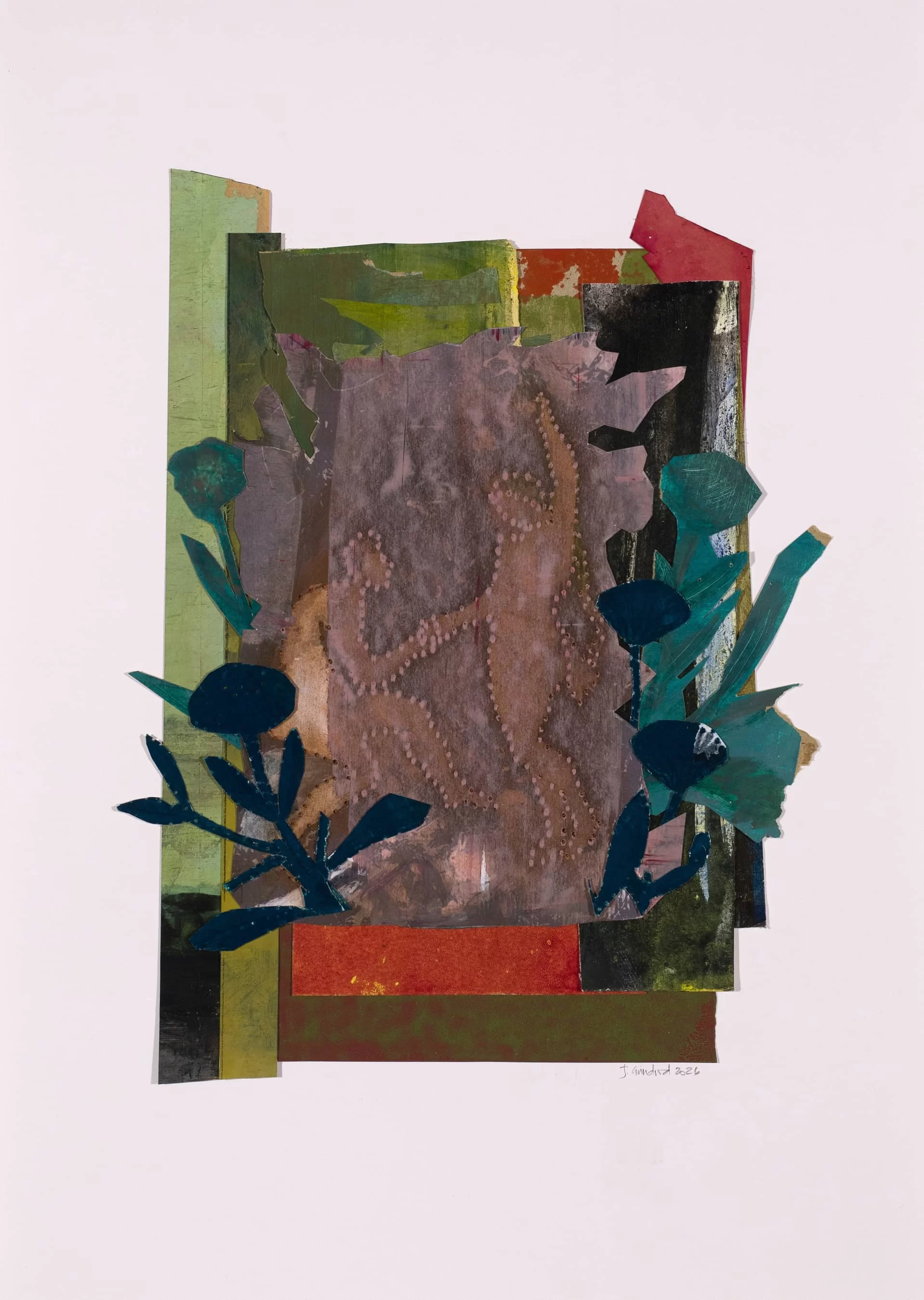
Collage on paper, 420 x 594mm
Durban, 1970s. For the child, the world is new, beautiful, mysterious, a font of curiosity. The world is also patriarchal, racist, paranoid, cruel. The child is ambiently aware of this. From various injustices, she is protected and therefore implicated – not by choice but by design – in the fact of injustice. She remains insatiably curious about it, the world, particularly – as a nascent artist – its objects and colours, their shape and weight.
The child’s mother is involved with the African Art Centre, an initiative of the South African Institute for Race Relations. It is one of the only places in what is then known as Natal where Black artists and artisans can sell their work. There, she interfaces with objects she wouldn’t have otherwise encountered. Wood carvings of devilpeople and their pitchforks. Beaded belts and a lion with a beaded mane. Items both beautiful and utilitarian: sleeping mats, tractor-tyre sandals, beer strainers, candlesticks made from beer cans.
Among these objects are tapestries from Rorke’s Drift, a missionary art and craft centre established by Swedish benefactors in the early 60s. They were woven by a woman, or a team of women: Dorothy Sibiya, perhaps, or Philda Majozi, Ellina and Elisa Xaba, Anna Magubane, or Mary Shabalala, among many other weavers.
The child imbibes these images: their colour, texture, immediacy, their treatment of form, which verges on the geometric. Their wool is coarse, handspun karakul. They do not look exactly like the Natal in which she is growing up – the animals are slightly supernatural, the figures somewhat pixelated – but they are undeniably of that place. A familiar elsewhere.
Later, when the child is a woman, she will encounter similar compositions in the work of Kandinsky, similar abstract colour use by Miró. For now, a child still, she is only vaguely aware of an art historical canon that presupposes a hierarchy of images. For her, for now, these tapestries are sources of endless delight and fascination. They are not merely decorative; they are resonant. Art.
The child is Josephine Grindrod, an artist who has created a body of work for Untitled using an unattributed tapestry, Birds and figures (c. 1960s) – which the artist acquired in 2024 – as a cipher for those other objects she is attempting to recall from childhood, questioning to what extent she has, implicitly or otherwise, drawn inspiration from these practitioners in the intervening decades. This body of work also includes two prints that Samukelisiwe Majola – a recent Ruth Prowse graduate who grew up in KwaZulu-Natal and works primarily in the tradition of weaving – made in the artist’s studio, acknowledging the chain of inspiration that links the practitioners of Rorke’s Drift to a new generation of artists in the present day.
Grindrod’s two most recent exhibitions – Fecund: A Garden of Earthly Delights (a duo show with Jann Cheifitz) and Small Fables (a solo), both presented at Everard Read in Cape Town – saw the artist hone various techniques to reimagine archetypal images: characters from illustrated storybooks, Greek mythology, biblical imagery. She photocopies references, blows them up, cuts them apart, collages them anew. She uses the pouncing technique to trace their outlines, transferring punctuated silhouettes from one work to another. She paints them, sometimes faithfully, like a study; other times, more obscurely, like a shadow.
Grindrod’s presentation involves similar methods applied to the Rorke’s Drift tapestries and related artefacts. She has pounced belts to study how their beads were laid. Copied motifs across oil paintings and watercolours. Developed swatches of colour references drawn from the tapestries and telephone wire imbenge, which she has gathered into assemblages called ‘stacks’. Scanned, reproduced, and blown up images of the tapestry to get up close to the materiality of its construction, the ineffable magic begotten where warp meets weft.
In particular, Grindrod is interested in the questions that arise when engaging in this process. When she copies an image of Sleeping Beauty, Persephone, or Eve, she is entering into the centuries-old tradition that permits an artist to lend the thread of her own style to the skein of shared meaning-making called canon in the West. When she copies a diamond-shaped motif from a Rorke’s Drift tapestry onto the background of a painting of the mythological figure Psyche, she wades into murkier waters.
Is she working in the primitivist vein of, say, Picasso or Matisse, who have been critiqued for their gaze that Others the West African artistic styles that they borrow? Or is she honouring the entirety of the aesthetic world that has influenced her life as a maker? The fact that Grindrod references Picasso’s collages and Matisse’s cut-outs as she deconstructs these various fragments of childhood memory and South African art history suggests an attunement to hybridity. Poetry is possible in that which remains irreconcilable; it is her sensitivity to this that lends Grindrod’s work its emotional power.